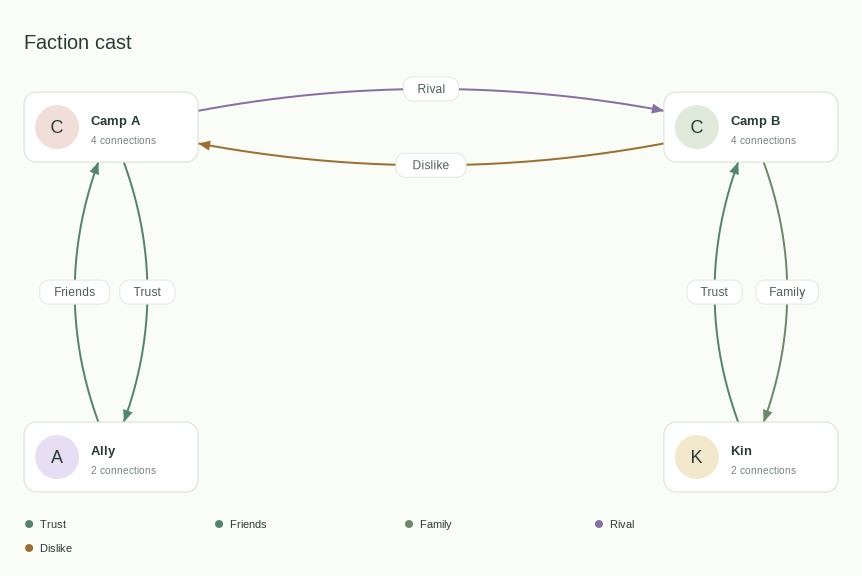
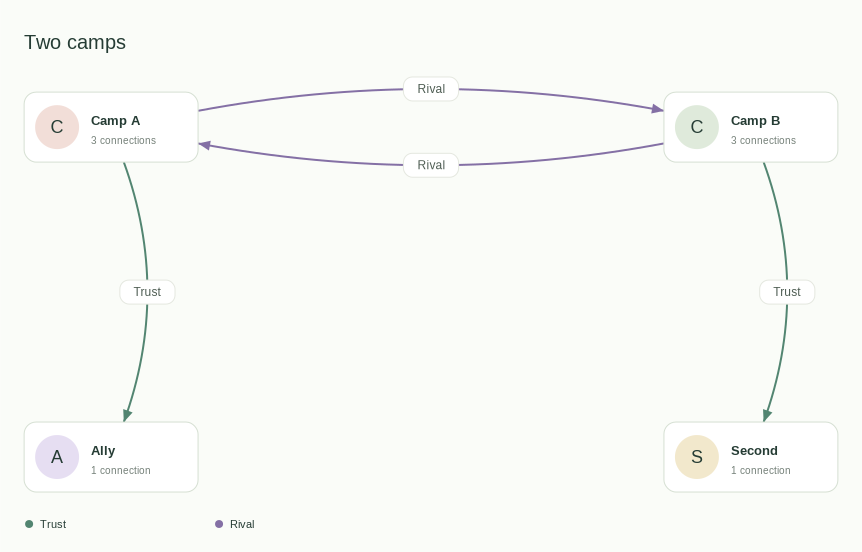
Each card is a static faction example for this template: a faction cast, and two camps. The link opens this same template in the editor so you can rename Camp A and Camp B.
A character relationship chart for a whole story cast shows the shape of the conflict: who is on which side, who holds each group together, and who stands between them. This template starts with two groups and one character caught in the middle. The example uses five original people so you can see loyalty inside a side, hostility across the gap, and a friendship that crosses it without becoming a truce.
What's in this template
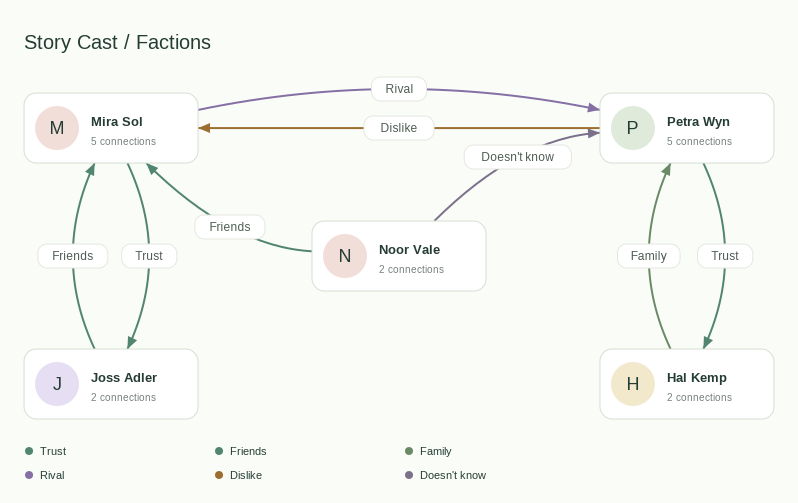
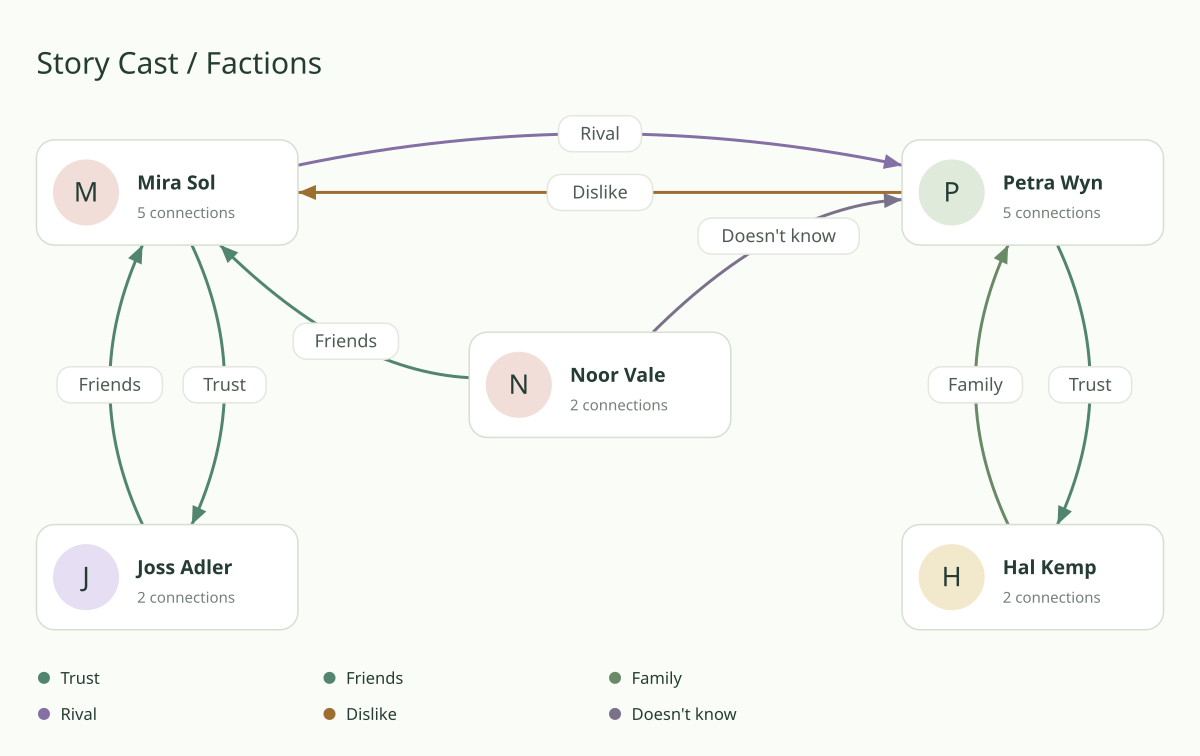
Mira Sol and Joss Adler stand on the left. Petra Wyn and Hal Kemp stand on the right. Noor Vale stands in the center, in the gap between the pairs. There are eight arrows. Inside the left pair, Mira trusts Joss and Joss calls Mira a friend. Inside the right pair, Petra trusts Hal and Hal calls Petra family. Across the divide, Mira sees Petra as a rival and Petra dislikes Mira. Noor counts Mira as a friend and does not know Petra.
The two sides are not mirror images. Family on the right is a tighter bond than friends on the left, and Noor's two arrows do not treat the sides equally. That imbalance is the useful part. A chart where both factions have the same feelings, and the person in the middle likes everyone, has not yet told you who would actually change sides.
How each arrow in the cast reads
Mira trusts Joss Adler. The arrow points from Mira to Joss. Inside a faction, trust is the practical bond: Mira would give Joss the key, the location, or the vote. It is the reason these two read as a side rather than two people who happen to stand on the left.
Joss sees Mira as a friend. The return arrow is Friends, not Trust. Joss likes Mira and would claim the friendship. Joss has not said they rely on Mira the way Mira relies on Joss. A faction held together by unequal trust is already a story. If your left side is a sworn pair, change Joss's label to Trust or Family. If Joss is about to leave, the friend label is the last polite version of the bond.
Petra trusts Hal Kemp. On the right, the arrow from Petra to Hal is also Trust. The label matches Mira's, which makes the two sides easy to compare. Both people you might read as leaders rely on their second person. The similarity is there so the difference can show up in the return arrows.
Hal sees Petra as family. Hal's arrow points to Petra with Family. The right side is not only a working alliance. Hal treats Petra as kin, whether that is blood, marriage, or a found household. It is a stronger glue than Joss's friendship, so the right side is harder to split with an argument and easier to warp with a family obligation. When you rename this pair, decide whether the side is a crew or a household. The label is that decision.
Mira sees Petra as a rival. The arrow crosses from left to right. Rival means Mira takes Petra seriously as competition: the other candidate, the other captain, the heir across a war. The rivalry points at Petra, not at the whole faction. Mira has no arrow to Hal. The conflict has a face.
Petra dislikes Mira. Petra's arrow comes back with Dislike. She is not framing this as a fair contest. Dislike is personal. The two cross arrows disagree about what the fight is. Mira's word is rivalry. Petra's word is hostility. Keep the mismatch if one person thinks this is politics and the other thinks it is personal. Make the labels match if both sides would use the same word.
Noor counts Mira as a friend. Noor's arrow points left, to Mira, with Friends. This is the tie that crosses the gap. Noor is not a member of Mira's pair, and the friendship does not put Noor under Mira's trust. It gives Noor a reason to be allowed in the room. There is no return arrow from Mira to Noor in the example. Mira has not labeled Noor at all. That absence is not one of the eight relationships. It is a gap you can fill when the middle character needs an answer from the left.
Noor does not know Petra. The last arrow points from Noor to Petra with Doesn't know. Noor has a friend on the left and no reading of the person on the right. That is a specific kind of middle: not a double agent and not a diplomat, a person who has only seen one side clearly. If Noor is a spy, replace Doesn't know with a custom label such as reports on Petra or owes Petra. The template uses Doesn't know so the imbalance is visible before you complicate it.
Who it's for
Novelists and screenwriters use this when a draft keeps introducing people faster than the alliances can be remembered. Game masters use it to map NPC factions before a session, so a rival court, a guild, and the one contact who drinks with both are on one page. Worldbuilders who already know the politics in prose can turn them into a character relationship map and check that the loyalties they have described are actually different from each other.
It fits any cast that has sides: a royal court, a ship's crew, rival schools, two families, two investigations. It is the wrong first chart when you only care about one protagonist's private feelings. Put that person on the OC template. Come here when moving one character to the other side would change the plot.
How to split an ensemble cast into factions
Split on the choice that creates the plot, not on a personality quiz. In the example the split is already drawn: Mira and Joss on one side, Petra and Hal on the other. Yours might be the crew that wants to surface and the crew that wants to dive, the heirs of two houses, or the classmates who reported an incident and the classmates who covered it up.
Give each side a reason to stay together, and put that reason on an interior arrow. Trust, Family, and Friends are the usual labels inside a side. A side with no interior arrows is a list of names standing near each other, not a faction. Name the side in the chart title, or in a note on the person who holds it together. Mira's card can carry a note such as north house. The arrows stay short.
Keep the first pass to two sides. A third faction is easy to add with + Character and a new cluster dragged to another corner, and it is also easy to make the picture unreadable.
Do not give every member an arrow to every member of the other side. Mira's rivalry points at Petra, not at Hal. The reader can see who the conflict is between.
If someone hates an entire faction, you can draw several Dislike arrows. Start with the one relationship that would survive if the conflict ended. That is the one you will write scenes about.
Leave a gap wide enough for the cross arrows to show their labels. Drag each side into its own cluster. The gap is not a third faction unless someone is standing in it.
Two sides plus one person in the gap will show you whether the conflict is real before you invent a neutral council, a secret order, and a comic cousin. Add those when a scene needs them, not because the chart looks empty.
The person standing between two sides
Noor is not a faction of one with balanced ties. Noor likes Mira and does not know Petra. A middle character can be several other things, and the labels should say which.
A messenger trusts one side and is family to the other, and both sides know it. Give them an arrow into each side, and a return arrow from each side, so the job is acknowledged rather than implied by the card's position.
A double agent can show a friendly label to both. The chart of public feelings will then look like a genuine bridge. If the deception matters, a custom label such as lies to Petra is clearer than Friends. A hostage, a child, or a newcomer can look like Noor: one real friendship and a lot of Doesn't know. Do not balance them with a matching friendship on the other side unless the story has earned it. The imbalance is why they are in the middle.
Someone who refuses both sides needs outgoing arrows that say so. Dislike toward the leader of each side, or a custom label such as will not swear, tells the truth. Standing in the gap with no arrows does not. It only says you have not decided. When the middle character picks a side, drag the card into that cluster and change the arrows. A defection is an edit. It does not need a new file.
How to make your own in 3 steps
Name the two sides before you decorate them. Open the template, rename Mira and Joss as one group and Petra and Hal as the other, and rename Noor as the person in the gap. Put a faction note on the card of whoever holds each side together. Use + Character for a missing member and drag that card into the cluster it belongs to. Delete a card if one side should be a single person.
Label the interior bonds first, then the conflict. The example arrows are already drawn. Click an arrow to change its label. Trust, Family, and Friends belong inside a side. Rival and Dislike belong across the gap. Write your own label when those words are too vague. To add a missing direction, select a character, click Connect, and click the person the arrow points to. One direction holds one label. The example's eight arrows are a complete small cast. Yours can be fewer. An arrow from everyone to everyone hides the split.
Decide what the middle character knows. Set Noor's left and right labels separately. Add the reverse with Add [name]'s side when Mira or Petra has an opinion about that person, or tick Also add their perspective while you connect. The example leaves Mira's reply to Noor undrawn so you can see a gap. Fill it if your story has an answer. Then export at 2x to check the clusters, or at 4x when the cross-gap labels need to stay readable.
The cast stays in this browser until the site data is cleared. File, then Download project file, writes a backup you can import on another device. If a label sits on a card, drag the clusters farther apart before you export. The export uses the positions you leave.
Do the two factions need the same number of people?
No. The example has two and two, plus Noor, because that is easy to read the first time. A single leader on one side and four people on the other is a clearer story than padding the small side with cousins you do not care about. Add a person only when they have a relationship you are willing to label.
How do I show someone who is loyal to both sides?
Give them an arrow into each side, with the loyalty named. Trust toward one leader and Family toward the other says more than placing the card in the middle and hoping the position is read as politics. Add the return arrows if those sides claim the person back. A card between the clusters, with no arrows, does not say which loyalty would win.
Should everyone in a faction connect to everyone else?
Connect the bonds that hold the side together, not every acquaintance. Mira trusts Joss. She does not also need a Friends arrow if Trust is the real bond. A large faction often has one center person and several arrows pointing at them, which is enough to see the group. On a relationship map, a web of matching lines between all members looks busy and says less.
Can I paste this story cast chart into Word, Excel, or Google Sheets?
Yes. Export a PNG of this story cast chart, then paste or insert that image into Word, Excel, Google Docs, or Sheets. The file is a picture. Keep Download project file if you still need to change an arrow label later.
Can I use this story cast chart commercially?
Yes for your own characters and story materials on this story cast chart. You keep the names, pictures, and labels you add. The free PNG export is without a watermark. Do not present the starter cards as licensed art from someone else's show or game.
Is this story cast chart free, and is Download PNG without a watermark?
Yes. Opening this story cast chart, editing it, and exporting a PNG are free. You do not need an account, and Download PNG is without a watermark.