A novel character map shows the people in a book and the direction of each tie. This template places the Lorne household on the left and Orla Voss's group on the right. Family arrows stay inside a group. A rivalry, a debt, and a secret cross the gap. Open the chart and replace the names with the cast of your book.
What's in this template
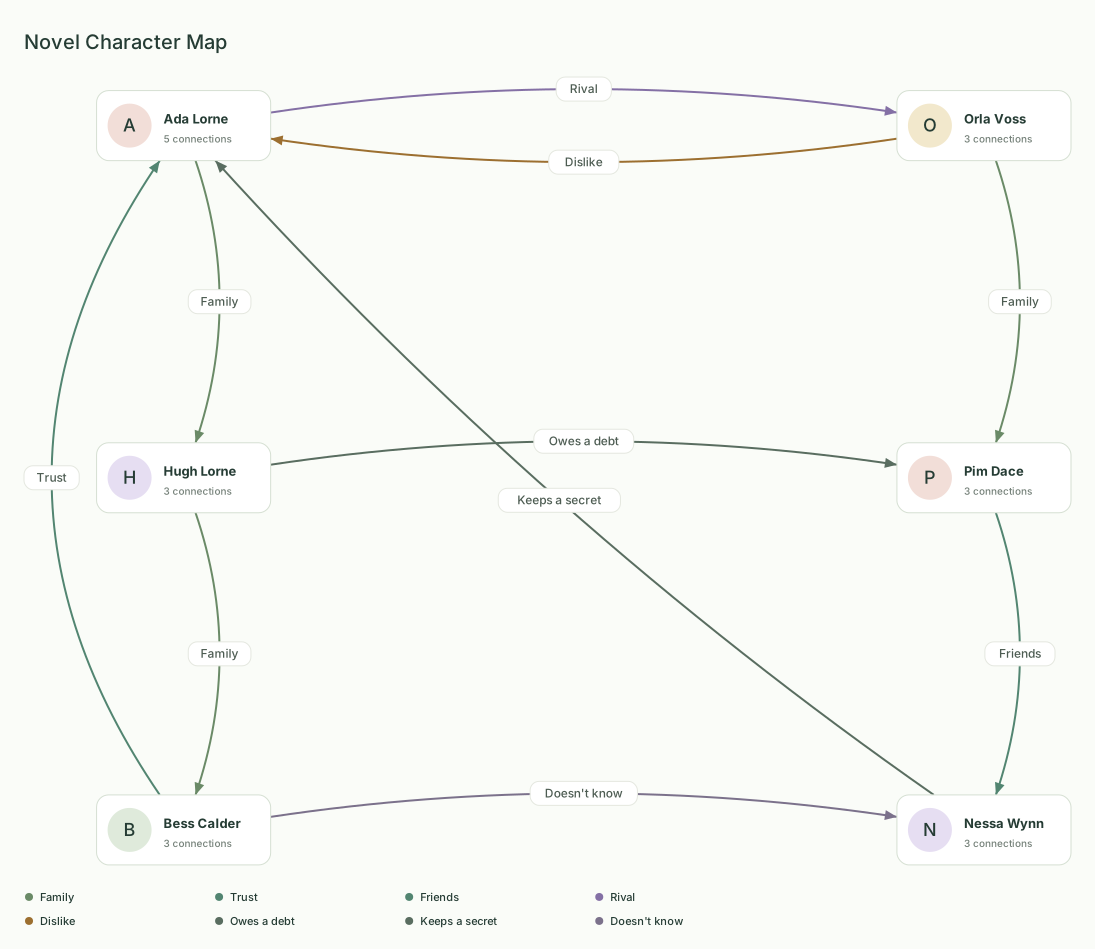
This book character map template has six people and ten arrows. Ada Lorne, Hugh Lorne, and Bess Calder stand on the left. Orla Voss, Pim Dace, and Nessa Wynn stand on the right. The left three are a household. The right three are the people the household is up against. The file does not store a house name. You drag a card into the other cluster when the story moves that person, and a short note on Ada's card can say Lorne house if you need the word saved.
Inside the household, Ada calls Hugh family, Hugh calls Bess family, and Bess trusts Ada. Inside the other group, Orla calls Pim family, and Pim counts Nessa as a friend. Those five arrows are why each cluster reads as a group. The other five leave their cluster. Ada rivals Orla, and Orla dislikes Ada. Hugh owes a debt to Pim. Nessa keeps a secret from Ada. Bess does not know Nessa. Count them before you edit: ten lines, ten decisions.
How the arrows in this novel map read
Ada calls Hugh Lorne family. The arrow stays inside the household and points from Ada to Hugh. Family here is kinship she already treats as given: sibling, parent, spouse, or the person who raised her. It is the kind of tie, not a score for how kind the house is. Hugh has not answered Ada on this pair. If he claims her as family too, add his side. The example leaves the return undrawn so a one-way family claim is visible.
Hugh calls Bess Calder family. His arrow points down to Bess, still inside the household. The house is now a chain rather than one feeling copied onto every pair. Ada is tied to Hugh, and Hugh is tied to Bess. Ada has no arrow to Bess in the example. Add it if your household is a triangle where the third bond matters. Leave it off when Ada and Bess share a roof and still have no separate claim you would write.
Bess trusts Ada. The arrow runs from Bess back up to Ada with Trust. Trust is practical: Bess would give Ada the letter, the key, or the warning. It is not the same word as family. A household can be family at the top of the chain and a working reliance one step across. If your version of Bess is only polite, change Trust. The template uses it so the return inside the house is a different kind of bond from the family arrows.
Orla calls Pim Dace family. On the right, the arrow from Orla to Pim is Family. That is the bond that makes the right cluster a group rather than two names standing near each other. Pim has not labeled Orla. The example keeps the claim one-way, the same way Ada's claim on Hugh is one-way. Change Pim's missing reply when your opposing group would answer out loud.
Pim counts Nessa Wynn as a friend. The arrow points from Pim to Nessa with Friends. Friends is the bond Pim would claim in dialogue. It is cooler than Orla's family label and warmer than a shared errand. The right side is not one feeling three times. The top of the cluster is kin. The middle of the cluster likes someone. Those are different chapters.
Ada sees Orla as a rival. This is the first arrow that crosses from the household to the other group. Rival means Ada takes Orla seriously as the opposing force: the other heir, the other keeper of a secret, the person a climax has to face. The arrow points at Orla, not at Pim and not at Nessa. The antagonist has a face. A chart that dislikes an entire cluster at once is harder to read than one named opponent.
Orla dislikes Ada. The return arrow comes back with Dislike. Orla is not framing this as a fair contest. Dislike is personal. The two cross arrows disagree about what the fight is. Ada's word is rivalry. Orla's word is hostility. Keep the mismatch when one person thinks this is a struggle over a goal and the other thinks it is personal. Make the labels match only when both people would use the same word.
Hugh owes a debt to Pim. The arrow leaves the household and points at Pim, and the label is the phrase Owes a debt. There is no arrow from Pim back to Hugh. Pim has not said whether he is collecting, forgiving, or unaware. Leave the reply missing when that silence is the point. Add Pim's side only when he has an answer you are willing to put in a scene. A missing arrow is a decision, not a label you forgot.
Nessa keeps a secret from Ada. The arrow leaves the right cluster and points at Ada, and the label is the phrase Keeps a secret. Nessa is not in Ada's household, and the secret does not pass through Orla on the chart. The line is the thing Ada does not know. When the secret breaks, you edit this label. You do not add a second arrow from Nessa to Ada. One direction holds the current fact.
Bess does not know Nessa. The last arrow points from Bess to Nessa with Doesn't know. Bess has no reading of Nessa yet. It is not dislike and it is not friendship. The household and the other group share a person who has only seen one side of that gap. Nessa has no arrow back to Bess. Fill Nessa's side when the other group has an opinion about Bess. Leave it blank when they have not met in a way the book cares about.
Those ten arrows are the whole example. Five stay inside a cluster: family, family, trust, family, and friends. Five cross: rival against dislike, a debt with no reply, a secret aimed at Ada, and a doesn't know with no reply. If your book drops a pair, delete the arrow. If it needs a reply this example skipped, draw it. Do not leave a label you no longer mean.
Who it's for
This is a character map for writers who are drafting a book and need the cast to stay distinct from chapter to chapter. Readers use the same chart for book notes after a chapter, when they want the households and the crossed lines in front of them rather than a list of names in a notebook.
Skip it when one original character is the only question, or when the plot is a romance among three people. Those layouts have their own templates. Open this one when a household and a rival group are both in the story, and a line between them would change a chapter.
Character map for novels and books
List the people a chapter would be lost without, straight from the manuscript, and put those names on cards. Ada Lorne, Hugh Lorne, and Bess Calder stand in for one household. Orla Voss, Pim Dace, and Nessa Wynn stand in for the other side. Rename that household before the rivals.
Group by family or by faction and drag each group to its own side. The chart stores no group name, so the cluster is the group. Arrows that stay inside a cluster are why that side holds: family from Ada to Hugh and from Hugh to Bess, and family from Orla to Pim.
Add the antagonist line when one pair, one person from each group, is who a chapter turns on. Ada's rivalry toward Orla is that line. Do not connect every Lorne to every Voss. Add Hugh's debt to Pim only if that pair changes a later chapter. For three groups, the character relationship map is the wider start.
Tracking a character map across chapters
Update the map when a chapter ends, and only the lines that chapter changed. A first meeting is a new arrow, or a Doesn't know that you replace with the feeling the scene earned. Bess's arrow to Nessa says Doesn't know. When they meet and Bess forms a view, click that arrow and change the label. A revealed secret is the same kind of edit. Nessa's arrow to Ada says Keeps a secret. When Ada learns it, replace those words. One direction still has one label, so the old phrase does not stay beside the new one.
A shift inside a house is an interior arrow. If Hugh stops treating Bess as family, change Hugh's arrow and leave Ada's family arrow alone if Ada has not changed her mind. The two directions are two facts. Removing a person who dies or leaves means deleting that card, and the arrows that touched the card go with it. A defector moves by dragging the card into the other cluster and rewriting the arrows that are no longer true.
Do not redraw the whole cast because one chapter was loud. The map helps when last chapter's lines are still visible and this chapter's edits are obvious. From the File menu, choose Download project file before a large revision. Import project reads that file back and waits for you to confirm before it replaces the chart on screen, so a false start does not have to become the only copy.
How to make your own in 3 steps
- Rename the household before you touch the other side. Open the template and click Ada Lorne, Hugh Lorne, and Bess Calder. Change the names to the people who share a roof or a sworn bond in your book. Then rename Orla Voss, Pim Dace, and Nessa Wynn, or delete a card the book does not need and add someone with + Character. Drag each card into the cluster it belongs to.
- Set the interior labels, then the lines that cross. The ten arrows are already drawn. Click an arrow and pick Family, Trust, Friends, Rival, Dislike, or Doesn't know, or replace Owes a debt and Keeps a secret with your own short words. A custom label can run up to one hundred characters, and two or three words stay readable on the arrow. Do not add a second arrow in a direction that already has one.
- Read the chart the way a chapter would. Check the household, then the other group, then each crossing. Select an arrow and use Add [name]'s side when the other person has an opinion, or tick Also add their perspective while you connect. Fill a gap when the book has an answer. Then click Export, choose 2x while you are still moving cards or 4x when the labels need to stay sharp, and choose Download PNG.
The cast stays in this browser until the site data is cleared. Download project file from the File menu when you want a copy you can import after a draft changes or you switch devices. The export uses the positions you leave, so separate the two groups before you export if a label sits on a card.
Prefer to start from an empty canvas? The step-by-step guide walks through characters, labels, a project file, and a PNG.
Questions about this novel character map
- How do I make a character map for my novel?
- Open this template and rename Ada Lorne, Hugh Lorne, and Bess Calder to the household in your book. Rename Orla Voss, Pim Dace, and Nessa Wynn to the other group. Click an arrow to change its label, delete an arrow the book does not have, and use + Character for someone the example skipped. When the groups read clearly, click Export and then Download PNG. The chart is saved in this browser while you work.
- What should a book character map include?
- Include the people a chapter would be confused without, grouped by household or side. Draw the bond that holds each group together, then the lines that cross: a rivalry, a debt, a secret, or a person who does not know the other side yet. Leave off acquaintances who never change a scene. One arrow is one direction, so two people can disagree about what they are to each other.