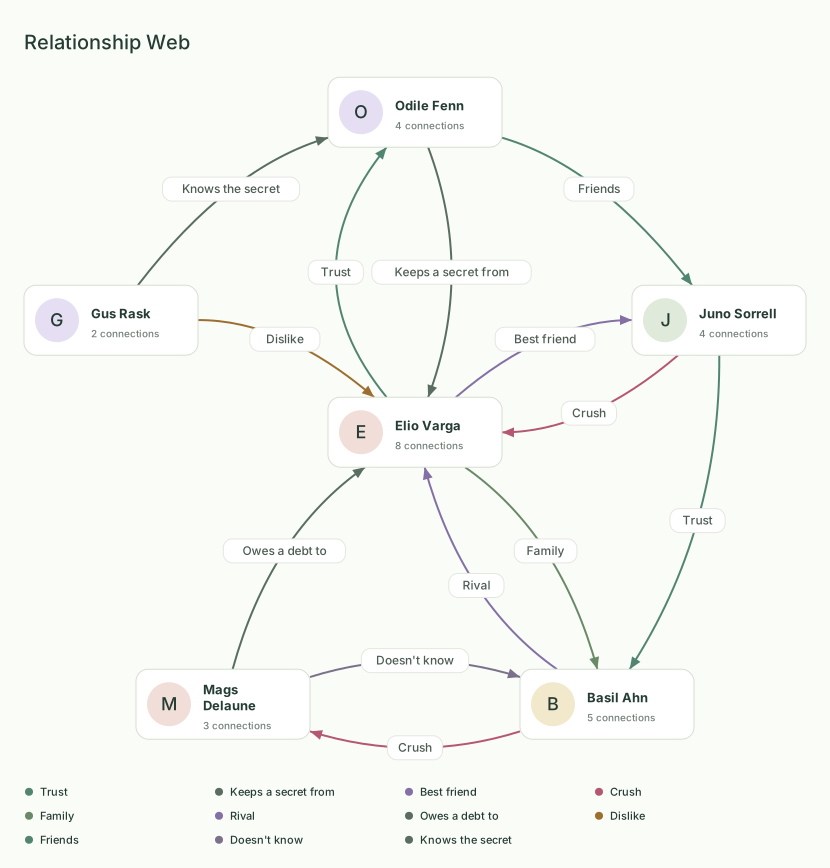
A relationship web is one cast drawn as a net. Writers also call that picture a character web or a character relationship web: one person near the middle, the people around them, and arrows between those people as well as arrows to the center. Each arrow points one way and carries its own label, so two characters can disagree. This page's drawing is the template. Open it in the free relationship chart maker, rename the six cards, and change any label before you export.
What's in this relationship web
Six original characters and thirteen arrows. Elio Varga sits in the middle. Odile Fenn stands above him, Juno Sorrell at the upper right, Basil Ahn at the lower right, Mags Delaune at the lower left, and Gus Rask at the upper left. Elio is the person the other five keep touching. The file does not store a group, a side, or a color that means a faction. Position is only where you dragged the card.
Eight of the arrows touch Elio. Three of those spokes leave him, and each one comes back with a different word. Two more point at him and stop: Mags owes him a debt, and Gus dislikes him, and Elio has no arrow to either of them. The other five arrows never touch Elio. They run around the outside, from Odile to Juno, Juno to Basil, Basil to Mags, Mags back to Basil, and Gus to Odile. A picture with only the spokes would be a hub. The outer five are what make this one a web. Count the lines before you edit: thirteen arrows, thirteen decisions.
How to read a relationship web
Elio trusts Odile Fenn. The arrow leaves Elio and points up at Odile, and the label is Trust. Trust is his claim: he would tell her the plan, the fear, or where he is going. The arrow does not say she has earned it, and it does not say what she would answer. That answer is the next arrow.
Odile keeps a secret from Elio. Her arrow points back down, and the label is the phrase Keeps a secret from, written for this chart rather than picked from the preset list. She is the person he trusts, and she is withholding something from him. The two labels are the mismatch. Closing the gap means editing her phrase. His Trust stays until you change that arrow yourself.
Elio calls Juno Sorrell a best friend. The arrow points from Elio to Juno with Best friend. That is his word for the person first in his life who is not being labeled as kin and not being labeled as a romance. Juno has a different word ready on the return arrow. The chart does not average the two into one line.
Juno has a crush on Elio. The return arrow points from Juno to Elio with Crush. She wants a romance. He has named a best friend. Both stay on the chart, so the feeling that is not returned stays visible. Change her label only when her feeling changes. Change his label only when he would use a different word. One direction holds one label.
Elio calls Basil Ahn family. The arrow from Elio to Basil is Family. Family means kinship he already treats as given: blood, marriage, or the household that raised them. It is the kind of tie, not a score for how kind the house is. Basil's reply does not say Family. The pair can share a household and still disagree about what the bond is for.
Basil sees Elio as a rival. Basil's arrow points back with Rival. He can be kin and still want to come out ahead of Elio at the thing they both care about. Rival is not Dislike. Basil is not trying to leave. He is trying to win against someone the chart also calls family on the other arrow. Keep the mismatch when the scene turns on that argument. Make the labels match only when both people would use the same word.
Mags Delaune owes a debt to Elio. The arrow points from Mags to Elio, and the label is the phrase Owes a debt to. There is no arrow from Elio back to Mags. He has not named her. On this chart he does not show that he knows the debt is there. Leave the reply missing when that ignorance is the point. Add his side only when he has an answer you are willing to write. A missing arrow is not the same as a label you forgot.
Gus Rask dislikes Elio. Gus's arrow points at Elio with Dislike, and there is no return. Elio has not labeled Gus at all. The dislike is real for Gus and absent from the center of the picture. That is a one-way spoke, different from a pair that disagrees and different from a card you have not thought about. The label is a decision. The missing reverse is also a decision. Together, Mags and Gus are the two people Elio does not answer.
Odile counts Juno Sorrell as a friend. This arrow leaves Odile and points at Juno, and it never touches Elio. Friends is a bond Odile would claim out loud. It sits on the outer ring, so the web has a relationship the center does not mediate. Juno has not answered Odile on this pair. Add that reply if your version needs it. The template leaves it as one arrow so an outer friendship can be one-way.
Juno trusts Basil Ahn. The arrow runs from Juno to Basil with Trust. Juno would give Basil the warning or the key. The trust does not pass through Elio, and it does not file the two of them under a shared name. It is one directed fact between two people who also have their own ties to the center. If Basil relies on Juno too, add his side. The example does not, so the reliance stays hers.
Basil has a crush on Mags Delaune. The arrow points from Basil to Mags with Crush. A crush can stay private, so the chart does not copy it onto her arrow. This is another outer line. The feeling lives off to the side of Elio, between two people who each already have a spoke into the center. Delete it if your cast has no such feeling. Keep it when a side romance would change a chapter the center is not in.
Mags does not know Basil. Her arrow points back at Basil with Doesn't know. She is not refusing him and she is not matching the crush. She has no reading of it yet. Basil's Crush and her Doesn't know are a pair that disagrees in kind, in the same way Elio and Juno disagree, only this pair never touches the center. When she notices, replace Doesn't know with the feeling she actually has.
Gus knows the secret. The last arrow points from Gus to Odile with the phrase Knows the secret. It ties Gus to the thing Odile is keeping from Elio. The line does not go through Elio, so the secret can move between two side characters while the center still trusts Odile. That outer link is a scene the hub is not in. Without it, and without the other four outer arrows, the drawing would only say how five people feel about one.
Read the thirteen labels as one net. Elio has eight arrows in or out, which is why he reads as the hub. Mags and Gus each point at him and get nothing back, so he does not show the debt or the dislike. He trusts Odile while she keeps a secret, and Juno's crush comes back from him as Best friend. Gus's arrow to Odile can start trouble Elio is not in the room for. Nobody is isolated. Gus has two arrows, and everyone else has more. If your version drops a line, delete it. If it needs a reply this example skipped, draw it. Do not leave a label you no longer mean.
Web or hub: when to use this template
Use a hub when the only question is how one original character meets the people around them. Spokes are enough for that, and the OC relationship chart template is the chart that stops at those spokes: your character in the middle, and a label for how they see each person and how that person sees them. Open this web when the people around the center also have relationships with each other. An outer arrow is the difference. If you delete the five arrows that skip Elio, what remains is a hub. If you keep them, a side character can change the plot without asking the center.
Move to separate clusters when the story is about sides. The character relationship map is the template for several groups and the arrows that cross between those groups. This web has no groups to name. Dragging two cards closer together does not create a side, and nothing on the chart stores one. If you need sides, switch templates rather than hoping a gap on this page will be read as a border.
Relationship web maker
The editor draws each character as one card and each direction as one arrow. You drag the cards yourself. You pick a preset label, or you write a short phrase of your own. This template already uses both. Ten arrows use presets: Trust, Best friend, Crush, Family, Rival, Dislike, Friends, and Doesn't know. Three arrows use phrases written for this cast: Keeps a secret from, Owes a debt to, and Knows the secret. The same controls are what an oc relationship web maker is for. You rename the cards, and you change the labels. The chart is saved in this browser while you work.
A phrase you write has to stay short enough to read on the arrow. The field accepts up to one hundred characters. Two or three words stay readable in the PNG. A longer note belongs on the card, not on the line. Preset labels already cover the common words. Write your own when those words miss the fact, the way a secret and a debt do here. One direction still holds one label. The other person's answer, if you want one, is a second arrow.
For writers, fandoms, and game masters
Novelists use the web when a cast has a person everyone seems to know, and the chapters keep revealing bonds that person is not part of. The outer arrows are those bonds. Fanfiction and alternate-universe stories use the same shape when side characters have lives that do not route through the lead. One-way labels matter there, because a story often turns on the feeling that is not returned: a crush against a friendship, a trust against a secret, a debt the other person has not acknowledged.
Game masters running a D&D or other TTRPG session can draw the non-player cast as this kind of net, and the editor's Adventure Party starting point is a separate five-person ring for the player group.
How to make a relationship web in 3 steps
- Rename the center first, then the five around them. Open the template and click Elio Varga. Change the name, and add a picture if you have one. Pictures are cropped in this browser and are not uploaded. Then rename Odile, Juno, Basil, Mags, and Gus, or delete a card you do not need and add someone with + Character.
- Rewrite each arrow from the point of view of the person it starts from. The thirteen arrows are already drawn. Click one and pick a preset, or replace the custom phrase with your own words. Delete an arrow your story does not mean. Do not add a second arrow in a direction that already has one. Elio's Trust and Odile's secret are two edits, not one.
- Add at least one arrow between two side characters, then export. Select a side character, click Connect, and click the other person. Choose a preset or write a phrase, then click Add connection. The outer arrow is what keeps the chart a web. When the labels read clearly, click Export and then Download PNG.
The chart stays in this browser until the site data is cleared. From the File menu, choose Download project file when you want a copy you can import later, including on another device. Import project reads that file back and does not replace the open chart until you confirm.
For the same work starting from an empty canvas, use the step-by-step guide, which covers the project-file backup and export.
Questions about relationship webs
- What is a relationship web?
- A relationship web is a cast on one chart: a center character, the people around them, and arrows that also connect those people to each other. Each arrow points one way and has its own label. A hub with only spokes is a different picture. The outer arrows are what make this template a web.
- How do I make a relationship web?
- Open this template, rename the six cards, and rewrite each arrow from the person it starts from. Keep or add at least one arrow between two side characters. Click Export, then Download PNG, when you want the image. The chart is saved in this browser while you work.
- Is this relationship web maker free, and do I need to sign up?
- Yes. It is free, and there is no sign-up. The chart is stored in this browser's localStorage. Names, pictures, and relationships are not sent to a server.
- Can one character feel differently than the other?
- Yes. Every arrow is one direction. Elio can trust Odile while Odile keeps a secret from him, and Juno can feel a crush while Elio calls her a best friend. The return, if you want one, is a second arrow with its own label. You can leave the return undrawn, as this template does for Mags and for Gus.
- Is there a free relationship web maker with no watermark?
- Yes. RelationCanvas is free and does not ask you to sign up. Click Export to open the preview, then click Download PNG. The file is the chart only, without a watermark.