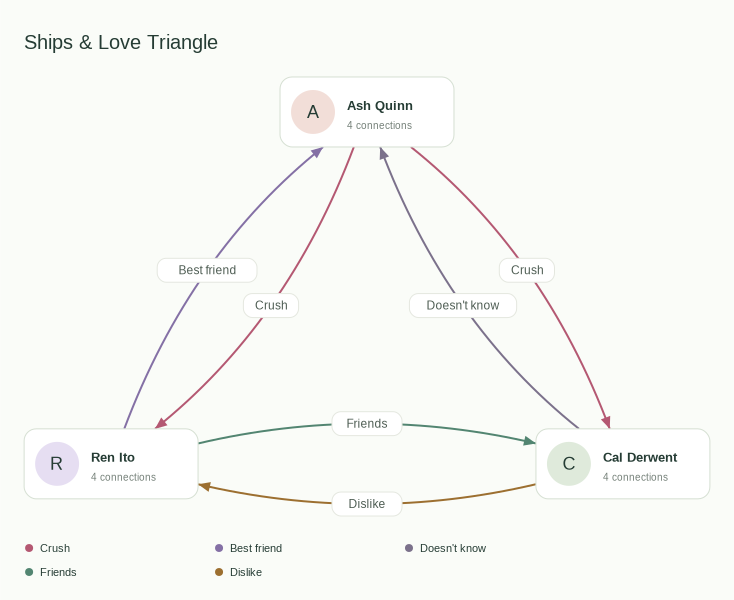
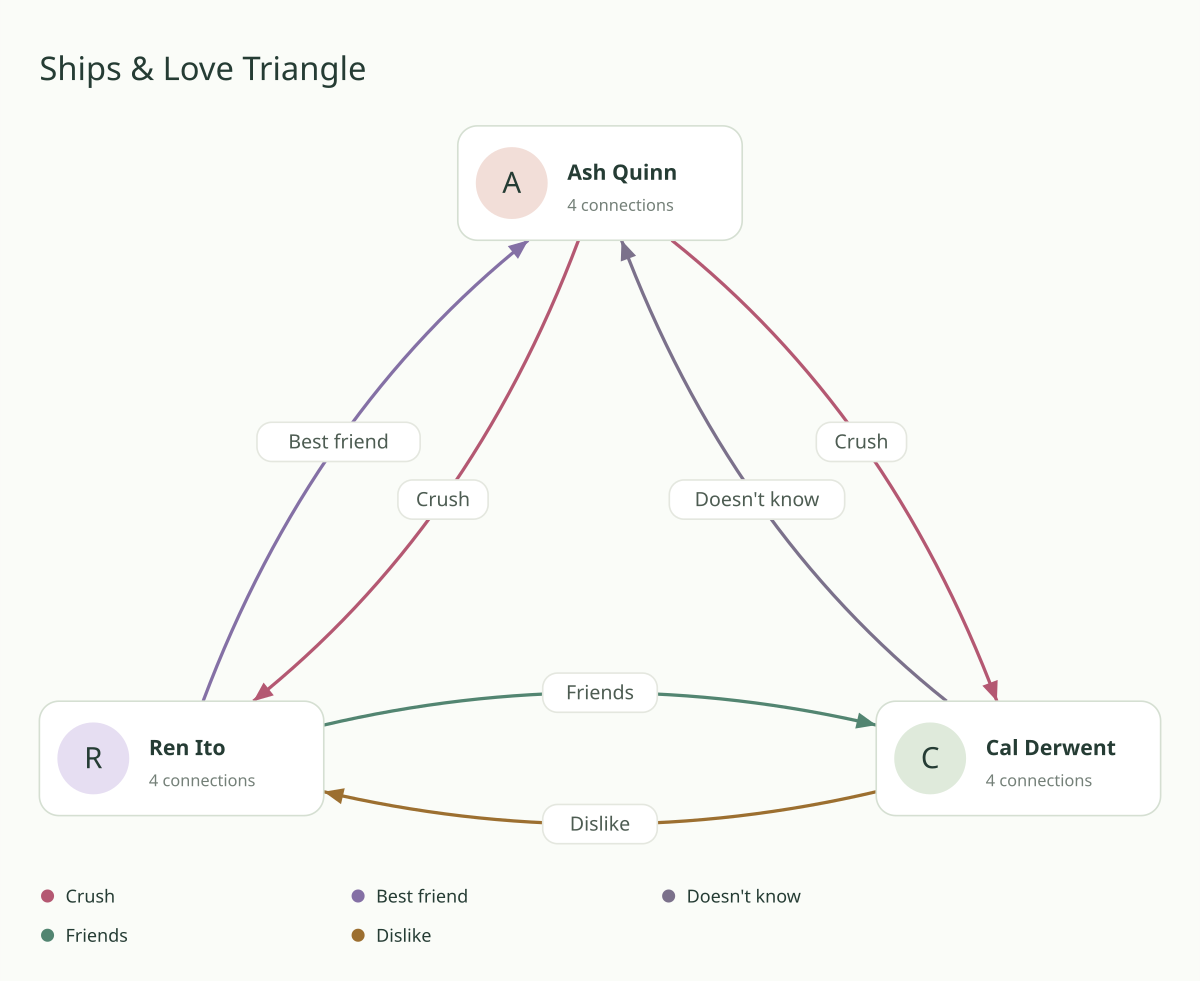
A ship chart is a small relationship map for a romance. It shows who feels what, and a love triangle is where those feelings stop matching. This template gives each direction of a pairing its own label, so "Ash has a crush on Ren" and "Ren sees Ash as a best friend" can sit on the same two characters. The drawing below is that triangle. Further down are the other shapes writers usually mean by the same phrase, and how to rebuild them from these three cards.
What's in this template
Three original characters, six arrows, every pair labeled in both directions. Ash Quinn stands at the top. Ren Ito is lower left. Cal Derwent is lower right. Ash has a romantic feeling toward both Ren and Cal. Neither feeling comes back as a crush. Ren and Cal have their own bond, and it is not a romance: Ren calls Cal a friend, and Cal dislikes Ren.
The chart is small on purpose. A triangle gets hard to read once a fourth person is doing as much romantic work as the first three. Add that person only after these six labels say what you mean. Until then, the picture is the argument: who wants whom, and what the other person thinks that is.
How each side of the triangle reads
Ash has a crush on Ren Ito. The arrow points from Ash to Ren. This is the ship Ash would name if someone asked. It does not require Ren to want the same thing, and the chart does not draw it as one mutual line.
Ren sees Ash as a best friend. The return arrow points from Ren to Ash. Best friend is a real relationship, not a softer way of writing no. Ren wants Ash in their life. Ren does not want the romance Ash wants. If you are writing a slow burn, this is the starting mismatch: the friendship is genuine, the crush is not returned, and you change Ren's label only when the story earns it.
Ash has a crush on Cal Derwent as well. A second crush arrow leaves Ash and points at Cal. Ash is the pivot of this triangle, the person with two romantic arrows going out. That is one common shape. It is not the only one. Nothing in the tool stops you from moving the crush onto Ren or Cal instead.
Cal does not know about Ash. Cal's arrow points back at Ash with Doesn't know. Cal is not choosing Ash or refusing Ash. The crush has not become a fact Cal is reacting to. Use this when the ship is still inside one person's head. When Cal finds out, replace Doesn't know with the feeling Cal actually has, even if that feeling is dislike.
Ren calls Cal a friend. The arrow goes from Ren to Cal. Inside the triangle, this line stops the two corners from being strangers. Ren likes Cal. The friendship gives Ash a reason to worry, and it gives Cal a reason to be in the room. It is not a third crush.
Cal dislikes Ren. Cal's arrow points at Ren with Dislike. The corners do not match: Ren offers friendship, Cal does not want it. That tension keeps the triangle from being only a story about Ash liking two people. Pressure sits between Ren and Cal as well as between Ash and each of them. If your corners are allies, change Dislike to Friends or Trust. If they are exes, a custom label such as former lovers will say more than Dislike.
Read the six labels as three pairs. Ash and Ren disagree about what they are. Ash and Cal are a crush and a person who has not noticed. Ren and Cal are a friendship answered with dislike. Any one of those pairs can be the story. The other two explain why it is difficult.
Who it's for
This is for shippers comparing two pairings, fanfiction writers planning a slow burn, and romance writers who need to see which feeling is returned. Roleplayers use it when a triangle has been running across threads and the table does not agree what the third person feels. It is also the chart to open when a reader says the romance is confusing and you suspect the confusion is two opposite labels drawn as one line.
Skip it for a large ensemble whose main structure is politics, a crew, or two families. A triangle can live inside that cast later. Start here when three people and six directed feelings are the problem you are trying to see.
The 5 common love-triangle structures
Writers say love triangle for several different maps. This template starts as one of them. You can rebuild the others by editing labels, without adding a fourth person.
- The pivot. One person has romantic feelings for two others, and those two are not a couple. Ash is the pivot here: a crush toward Ren and a crush toward Cal. The story question is which feeling Ash acts on, and whether either person wants it.
- The chain. A likes B, B likes C, and C does not like A back. Point Ash's crush at Ren only, point Ren's romantic feeling at Cal, and point Cal's feeling elsewhere, or at nobody. The hurt moves one step along the line instead of sitting on a single pivot.
- The closed triangle. Each person has a romantic feeling for one of the others, and at least one of those feelings is not returned in kind. Three crushes can form a loop: Ash to Ren, Ren to Cal, Cal to Ash. It reads as a cycle rather than a choice. Change a crush to Best friend or Dislike when the loop needs a weak side.
- The friendship wedge. Two people want a romance, and a best-friend bond blocks it or protects it. Ren's best friend label toward Ash is this wedge on one side of the example. The friendship is not empty space. It is the obstacle, or the reason the romance would cost something.
- The unnoticed crush. Someone feels a great deal, and the person they want has not noticed. Cal's Doesn't know toward Ash is this structure, sitting inside the larger triangle. You can make the whole chart this simple: one crush, one doesn't know, and a third person who is a friend to both and never becomes a romantic option. Delete the extra crush labels if that is the story.
Most triangles on the page are a mix. Ash's chart is a pivot, plus an unnoticed crush, plus a lopsided friendship between the corners. Write the mix in a character note if you need to remember which structure you are in. The arrows are the structure. The genre word is not.
Mutual, one-sided, and uneven ships
A mutual ship is two arrows that agree: Crush and Crush, or a custom label such as in love on both. Draw both. One arrow with both names on it hides which person you mean, and you cannot later end the ship on only one side.
A one-sided ship is a crush, or any wanting you name yourself, with a return that refuses it, misses it, or names a different bond. Ash toward Ren is one-sided. Ren did not leave the arrow blank. Ren answered with best friend. Blank would mean you have not decided. Best friend means you have.
An uneven ship agrees about the kind of bond and not the intensity. Crush one way and a custom quietly in love the other, or Friends one way and Best friend the other. Ren and Ash are uneven in a stronger sense: the kind of bond changes, not just the volume. Cal and Ren are uneven too, friend against dislike. Short labels keep that readable in the export. Secretly jealous of Ren still fits on an arrow. A paragraph does not.
If the triangle becomes a square, use + Character and give the new person arrows only to the people they actually have feelings about. A square where everyone connects to everyone is four pivots at once, and the picture stops explaining the romance. Three clear pairs are more useful than six vague ones.
How to make a shipping chart for your OC ships
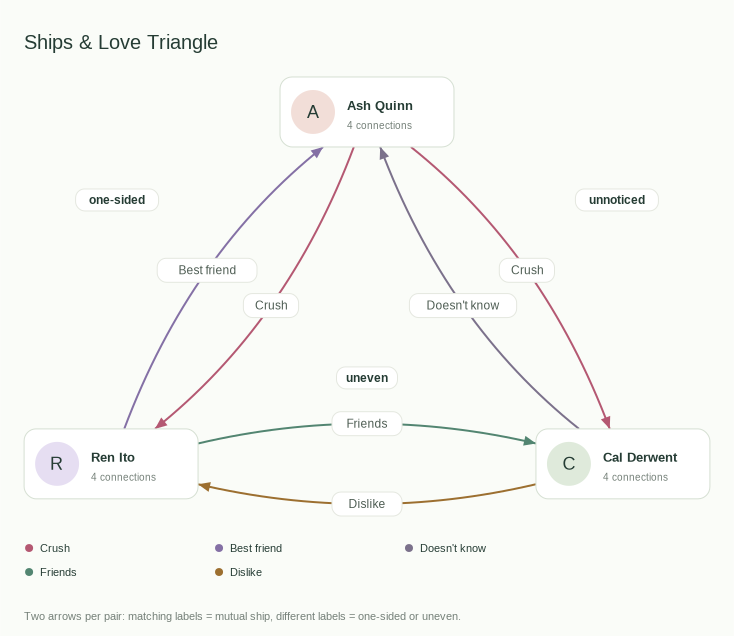
A shipping chart is the fandom name for a map of who you ship with whom. Most shipping charts are drawn by hand and posted as an image, with a line between each pair. The weak spot is that one line has to stand for both people. This template draws every pairing as two arrows, so a mutual ship, a one-sided crush, and a pair that only one person thinks is a pair all look different at a glance.
To turn this love triangle into a shipping chart, rename Ash, Ren, and Cal to your characters, then set each arrow to what that character feels: Crush, Best friend, Friends, Dislike, Doesn't know, or a short label of your own. Use + Character for every ship you want on the chart, and give new characters arrows only toward the people they have feelings about. When the pairs read the way you want, export a PNG or SVG. It is free, there is no watermark, and you do not need an account.
Make your own shipping chart with this templateHow to make your own in 3 steps
- Rename the three corners before you add anyone. Open the template and click Ash Quinn, Ren Ito, and Cal Derwent. Change the names, and add pictures if you have them. Pictures stay on your device. Decide who the pivot is, if you have one, and leave that person at the top so two outgoing crushes are easy to see.
- Set each direction to the feeling that person would admit. The six arrows are already on the chart. Click an arrow and change its label. Choose Crush, Best friend, Friends, Dislike, or Doesn't know, or write your own. Do not add a second arrow in a direction that already has one. Ash's two crushes, Ren's best friend and friend, and Cal's doesn't know and dislike are six separate choices. Change the one your story disagrees with.
- Read the triangle as pairs, not as a single knot. Select an arrow and use Add [name]'s side if a return is missing, or tick Also add their perspective before you add the connection. Check Ash with Ren, Ash with Cal, and Ren with Cal. Each pair needs a label you can say out loud. Export at 2x while you are still moving cards, and at 4x when you want the labels sharp.
Short labels survive better when the chart is shared as an image. Two or three words on an arrow is usually enough. The triangle stays in this browser. File, then Download project file, is the copy you can import after you clear site data or change devices.
Starting from a blank canvas instead? The guide on how to make a character relationship chart covers every step, including backups and export.
Need every step in detail? See how to map character relationships, step by step.
Questions about this ship chart
- Is a love triangle always three people who all want each other?
- No. The example is not that. Ash wants Ren and Cal. Ren wants Ash as a best friend and Cal as a friend. Cal has not noticed Ash and dislikes Ren. A triangle here means three people whose romantic feelings do not line up. Everyone wanting everyone else is the closed triangle, and you build it by changing labels rather than by starting over.
- How do I show a ship only one person wants?
- Draw the wanting as an arrow from that person, with Crush or your own words. Draw the other person's answer as a second arrow. Best friend, Doesn't know, Friends, and Dislike are all answers, and they are different stories. Do not put both people on one line. A later chapter where the ship becomes mutual is an edit to the second arrow.
- What should I label someone who has not noticed the romance?
- Doesn't know. It means they have no stance yet. It is not Dislike, and it is not a shy version of Crush. When they notice, replace it. If they notice and pretend not to, a custom label such as pretends not to see it is more honest than leaving Doesn't know in place.
- Can I paste this love triangle into Word, Excel, or Google Sheets?
- Yes. Export a PNG of this love triangle, then paste or insert that image into Word, Excel, Google Docs, or Sheets. The file is a picture. Keep Download project file if you still need to change an arrow label later.
- Can I use this love triangle commercially?
- Yes for your own characters and story materials on this love triangle. You keep the names, pictures, and labels you add. The free PNG export is without a watermark. Do not present the starter cards as licensed art from someone else's show or game.
- Is this love triangle free, and is Download PNG without a watermark?
- Yes. Opening this love triangle, editing it, and exporting a PNG are free. You do not need an account, and Download PNG is without a watermark.